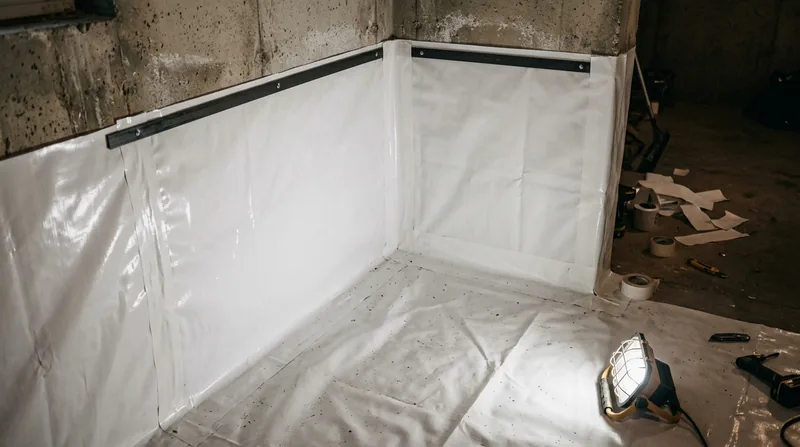




If your Bismarck basement smells musty in July and the block walls sweat through August, the problem is usually vapor driving through the concrete, not a leak you can see. Vapor Barrier Installation in Bismarck puts a heavy-duty sheet and sealed seams between that ground moisture and your living space, so the lower level stays dry instead of feeding damp air upstairs. The city sits where the Heart River meets the Missouri, and the soil tells the story: glacial till clay up on the bluffs, river-bottom silt and sand across south Bismarck that sat under water for months in 2011. Add deep frost, a hard spring snowmelt, and ice jams that push the river up in late winter, and you get a water table that climbs right against 1920s bungalow footings and 1990s poured walls alike. We install vapor barriers for those foundations, and we tie them into your drainage instead of stapling plastic to a wall and calling it done. Start with a free basement inspection and we will tell you plainly whether you need a barrier, a drain, or just better grading.
Why Bismarck Basements Sweat: Clay, River Bottom, and Deep Frost
Bismarck homes sit on two very different soils, and both push moisture vapor at the foundation. On the uplands, glacial clay holds water against the wall for weeks after a rain. In the river bottom near the Missouri and Heart, silt and sand wick groundwater upward under your slab all summer. Neither problem shows up as a puddle. It shows up as efflorescence, a musty smell, and block walls that stay cold and damp.
- Block and brick foundations in the Cathedral District and around the Capitol pull vapor straight through mortar joints.
- 1950s to 1970s ranches across south and east Bismarck sit on block basements that were never coated on the outside.
- Poured-concrete basements in north Bismarck and Lincoln still pass vapor through the slab and cove joint.
- Hard freeze-thaw cycles open hairline cracks that let vapor and liquid water both through.
A properly sealed barrier cuts that vapor load at the wall and floor, which is the first step before any drain work makes sense.
Key info: A 1952 ranch off South Washington had white powder creeping up the block walls every spring. The footing drain was working. The wall was not sealed against vapor. A dimple board barrier with taped seams fixed the dampness without touching the drain.
For the official word on what work needs a permit in this jurisdiction, check the City of Bismarck building department before scheduling structural or drainage alterations.
How We Install a Vapor Barrier in a Bismarck Basement
We do not guess at moisture. We read the wall first, then build the barrier to fit what we find. That means checking for efflorescence, probing the cove joint, and confirming whether hydrostatic pressure is already pushing water through cracks. If it is, a barrier alone will trap the problem, so we say so and point you to the right fix.
- We inspect the walls, slab, and cove joint and mark every damp zone and crack.
- We grind and parge rough block or brick so the barrier sits flat and seals tight.
- We hang heavy-duty dimple board or membrane sheets with overlapping seams and tape every joint.
- We terminate the sheet into the sump basin or interior perimeter drain so water has somewhere to go.
- We seal the top edge and floor termination and leave the wall able to dry inward where the system allows.
Every seam gets taped and every termination gets sealed, because a barrier with one open lap is just a wall with a plastic cover.
Key info: In a 1998 two-story in north Bismarck, the slab was dry but the cove joint wept after every thunderstorm. We tied the barrier termination into the existing sump pump basin and the dampness stopped within two weeks.
Vapor Barrier Approaches We Use in Bismarck
Not every basement gets the same sheet. The right approach depends on wall type, how much vapor is coming through, and whether a drain system is already in place. Here is how we match the method to the foundation.
| Approach | Description | Best for |
|---|---|---|
| Dimple board wall barrier | HDPE sheet with drainage channels, taped seams, sealed top and bottom | Block and brick walls with damp walls and efflorescence |
| Heavy poly membrane | Reinforced 10 to 20 mil sheet, mechanically fastened and taped | Poured walls in newer north Bismarck and Lincoln homes |
| Slab vapor retarder | Under-slab sheet installed during floor replacement or new pour | River-bottom silt and sand lots in south Bismarck |
| Barrier plus interior drain | Sheet terminated into a new interior perimeter drain and sump basin | Walls with active hydrostatic pressure and wet floors |
If the wall is actively leaking, the barrier goes in with a drain, not instead of one. That is the honest call, and we make it during the inspection.
Vapor Barrier Installation Cost in Bismarck: What to Expect
Most Bismarck vapor barrier work starts around From $3/sq ft of wall or floor area covered, and that figure is a starting point, not a quote. A straightforward dimple board job on a dry block wall sits near that number. A wall that needs grinding, parging, and a new sump tie-in lands higher, and a job that turns out to need an interior drain is a different scope entirely.
What moves the price: how much prep the wall needs, whether cracks have to be sealed first, whether a sump basin or discharge line has to be added, and how much access we have in a finished basement. Old brick and fieldstone in the Cathedral District takes more prep than a clean poured wall in Lincoln. Getting two or three estimates is smart, and so is asking each contractor what happens if the barrier is installed over an active leak. Our full pricing overview lays out how we build those numbers.
Choosing a Waterproofing Contractor Near Me in Bismarck
Anyone can staple plastic to a wall. The contractor you want reads moisture, understands how a barrier interacts with your drain and sump, and tells you when sealing is not the answer. Ask for proof of licensing and insurance before work starts, and get a certificate of coverage sent to you, not just a verbal yes.
Ask for references from Bismarck jobs on foundations like yours, and call them. Confirm who pulls any permit the work requires, since structural repairs and drainage alterations often need one and the rules vary by jurisdiction. If your neighborhood has an HOA, check its rules on exterior work and discharge lines before the crew arrives. We are a Basement Health Association member and we put our scope in writing. Reach us through the contact page and we will set up a free inspection.
One more thing worth knowing: a barrier is only as good as its terminations. Ask any contractor how they seal the top edge and the cove joint, and listen for a specific answer.
Vapor Barrier Installation in Bismarck: Pricing Guide
| Service | Price | Details |
|---|---|---|
| Dimple board wall barrier | Starting at $3/sq ft | Includes sheet, taped seams, and sealed terminations; wall prep and parging move the price up |
| Heavy poly membrane on poured walls | Starting at $4/sq ft | Covers reinforced sheet and fastening; finished basement access and crack sealing add cost |
| Barrier plus sump tie-in | On estimate | Needs an on-site look because basin location, discharge routing, and drain condition vary by home |
| Barrier plus interior drain | On estimate | Active hydrostatic pressure requires a drain design before any barrier number means anything |
| Travel | Included | in Bismarck and surrounding areas, no separate call-out or mileage fee |
| Estimate | Free | Response within 24h at (701) 450-3689, no obligation to book |
Indicative pricing, the exact cost depends on square footage, finish, and site access. Free personalized estimate within 24h at (701) 450-3689.


