



Bowing Wall Repair in Bismarck: When Clay and Frost Push Back
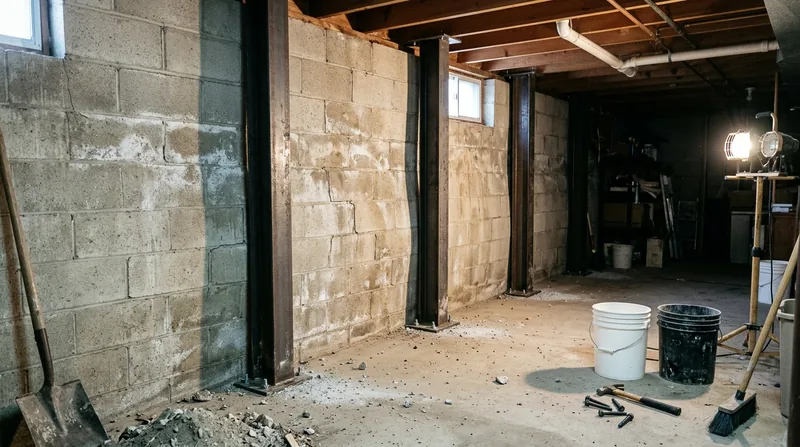
If you have noticed a basement wall leaning inward, a horizontal crack widening near the middle of the wall, or doors and windows that suddenly stick, you are looking at Bowing Wall Repair in Bismarck territory. Bismarck sits where the Heart River meets the Missouri, and the residential ground here is a mix of glacial till clay on the uplands and river-bottom silt and sand in south Bismarck. That clay swells hard when it takes on spring snowmelt and pushes against older block and brick foundations, especially after the deep frost of a Bismarck winter lets go. The housing stock tells the story: 1880s-1920s brick Victorians and foursquares in the Cathedral District, 1920s-1950s bungalows near downtown and in Highland Acres, 1950s-1970s ranches on block basements across south and east Bismarck and Mandan, and poured-concrete basements in the newer north and northeast neighborhoods and Lincoln. We stabilize bowing walls with carbon fiber straps, steel I-beams, or wall anchors, and we match the method to the severity of the movement and the soil under your footing. Foundation crack repair handles the leak itself, but a wall that is moving needs a structural answer first.
Why Bowing Walls Are Common in Bismarck's Older Basements
Most bowing walls we see in Bismarck are not a mystery. A block or brick basement wall is strong in compression but weak against sideways load, and the load here comes from saturated glacial clay and deep winter frost. When the soil around a 1950s ranch in south Bismarck stays wet through a heavy spring snowmelt, hydrostatic pressure builds against the wall and the middle of the wall deflects inward. Ice lenses in the frost zone do the same thing from the outside in late winter. Add the freeze-thaw cycles that hammer the region every March and April, and the wall moves a little more each year. The failure mode that dominates in Bismarck is horizontal cracking and inward bowing of older block walls from saturated clay and frost heave.
- A horizontal crack near mid-height of the wall is the classic sign that soil pressure is pushing the wall in.
- Efflorescence, the white salt bloom on the block face, tells you water has been moving through the wall for a long time.
- Sticking doors, a sloping floor, or a gap at the top of the wall where it meets the sill plate point to real movement, not just a leak.
- Walls that lean inward at the top are often a frost and backfill problem, while walls that bulge at mid-height are usually hydrostatic pressure.
- Old brick and fieldstone foundations in the Cathedral District and around the Capitol need a careful look because the mortar is often soft and the wall is thicker than modern block.
If you see any of these signs, get the wall looked at before you spend money on cosmetic patching. The North Dakota Secretary of State maintains the contractor licensing database at https://www.sos.nd.gov/, which is a good place to confirm who you are hiring.
Key info: A 1958 ranch off South Washington Street in Bismarck had a block wall bulging about 1.5 inches at mid-height after years of spring snowmelt against clay. We stabilized it with carbon fiber straps and addressed the water with an interior drain tile system, and the wall has held its position through several freeze-thaw seasons.
How We Stabilize a Bowing Wall in Bismarck
We start by finding out what is actually moving the wall. That means measuring the deflection, checking the soil and drainage on the outside, and looking for water entering the basement. Then we pick the repair method that fits the severity of the movement and the soil under your footing. A wall that has moved a quarter inch and a wall that has moved two inches do not get the same treatment. We also separate the structural repair from the water problem, because a stabilized wall still needs the hydrostatic pressure relieved if you want the basement to stay dry.
- We inspect the wall and measure the deflection with a straightedge and level, and we note crack widths and any floor or sill movement.
- We check the exterior grade, downspout extensions, and window wells to see where water is loading the soil against the wall.
- We recommend the method: carbon fiber straps for moderate bowing, steel I-beams for heavier movement, or wall anchors where the wall has to be pulled back toward plumb.
- We install the system and torque or tension it to the manufacturer's specification, and we seal the wall where water is entering.
- We correct the drainage that caused the pressure, often with an interior perimeter drain and a sump basin, and we test the system before we leave.
The goal is a wall that stops moving and a basement that stops taking on water, not one or the other. For the water side of the job, see our interior drain tile system page.
Key info: In Highland Acres, a 1940s bungalow had a wall leaning in at the top from frost and backfill pressure. We used wall anchors to bring it back toward plumb and extended the downspouts well away from the foundation, which took the load off the wall through the next spring melt.
Bowing Wall Repair Methods We Use
No single method fits every wall. The table below shows how we match the approach to the movement and the soil. We will tell you plainly when simple crack sealing is enough and when the real problem is hydrostatic pressure that needs drainage work as well.
| Approach | Description | Best for |
|---|---|---|
| Carbon fiber straps | Straps bonded to the wall from floor to sill plate to resist further inward movement. | Moderate bowing on block walls with cracks under about 1/4 inch. |
| Steel I-beams | Vertical steel beams set against the wall and tied into the floor and sill. | Heavier movement or walls that have lost structural capacity. |
| Wall anchors | Anchors driven into stable soil outside and tensioned to pull the wall back toward plumb. | Walls leaning at the top from frost or backfill pressure, with room to excavate outside. |
| Epoxy or polyurethane injection | Injection ports seal cracks and fill voids behind the wall. | Leaking cracks in a wall that has already been stabilized. |
We choose the method after we see the wall, because guessing from a photo can cost you money in the wrong direction.
Bowing Wall Repair Cost in Bismarck: What to Expect
Bowing wall repair starts from $600 for a focused stabilization job, and the price climbs with the length of wall involved, the method, and how much drainage correction is needed. A single carbon fiber strap on a short wall is at the low end. A full wall of steel I-beams or a wall anchor system on a long foundation is a bigger job. Access matters too: a wall behind a finished basement or tight to a property line in the Cathedral District takes more labor than an open wall in a newer Lincoln basement. We give you a written scope so you can compare like for like. Our pricing page lays out the ranges in detail.
- The length and height of the bowing wall is the biggest driver of cost.
- The method (carbon fiber, steel beams, or anchors) changes both material and labor.
- Whether drainage correction is needed at the same time affects the total.
- Access and basement finish level affect how long the job takes.
- Getting two or three estimates is smart because the diagnosis should match the repair.
Ask each contractor to explain why they chose the method, not just what it costs.
Bowing Wall Repair Near Me: What to Look For in a Bismarck Contractor
When you search for bowing wall repair near me in Bismarck, you will get a mix of general foundation firms, plumbers, and basement specialists. Ask for proof of licensing and insurance, and ask whether the crew doing the work is on the company payroll or subcontracted. Get at least two or three written estimates that describe the method and the scope. Ask for references from jobs in Bismarck or Mandan with similar walls, and check whether the contractor pulled the permits the local building department requires for structural foundation repair. Rules vary by jurisdiction, so confirm with the city before work starts. You can reach us through our contact page to set up an inspection.
Key info: A homeowner in Mandan got three estimates for a bowing block wall. One proposed exterior excavation and a full rebuild, one proposed only crack sealing, and we proposed carbon fiber straps plus drainage correction. The wall had moved about 3/4 inch, so the middle option would have hidden the leak without stopping the movement.
We are a Basement Health Association member and we focus strictly on below-grade work, so the diagnosis you get is from a specialist, not a generalist.
Bowing Wall Repair in Bismarck: Pricing Guide
| Service | Price | Details |
|---|---|---|
| Carbon fiber strap stabilization | Starting at $600 | Includes on-site assessment, strap layout, and installation on a short bowing wall section. |
| Steel I-beam wall stabilization | Starting at $1,800 | Includes beam layout and tie-in; wall length and basement access move the price. |
| Wall anchor system | Starting at $2,500 | Includes exterior anchor installation and tensioning; excavation access and wall length drive cost. |
| Crack injection with stabilization | Starting at $450 | Includes epoxy or polyurethane injection on a stabilized wall; number of cracks moves the price. |
| Complex or full-wall repair | On estimate | Needs an on-site look before a number because movement, soil, and drainage all interact. |
| Estimate | Free | Response within 24 hours at (701) 450-3689, no obligation to book. |
Indicative pricing, the exact cost depends on square footage, finish, and site access. Free personalized estimate within 24h at (701) 450-3689.


