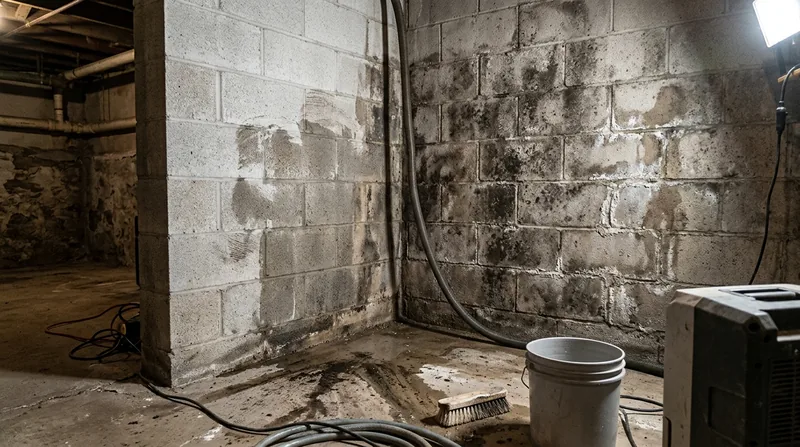




Why Basement Mold Remediation in Bismarck Starts With the Water, Not the Mold
Bismarck sits where the Heart River meets the Missouri, and that geography writes the rules for below-grade moisture. Homes on the bluffs deal with glacial till clay that holds spring snowmelt against the foundation, while the river-bottom silt and sand in south Bismarck stay saturated long after the 2011 flood line receded. Basement Mold Remediation in Bismarck only works when we find and fix the moisture source first, because mold on joists, rim boards, and drywall paper regrows within weeks if the wall behind it is still wet.
We handle containment, treatment of affected building materials, and the drainage or dehumidification fix that keeps the basement dry through the next melt. If you have already had a wet basement event, start with a free basement inspection so we can trace the water path before anyone sprays anything.
Old Brick, Block, and Poured Concrete: Why Mold Hits Bismarck Basements Differently
The building stock here splits into three moisture profiles, and each one grows mold for a different reason. Cathedral District and Capitol-area Victorians and foursquares sit on old brick and fieldstone foundations with no footing drain and lime mortar that stays damp. Mid-century bungalows and ranches across south and east Bismarck and Mandan have block basements that wick groundwater through the mortar joints. The 1990s-and-newer two-stories in north and northeast Bismarck and Lincoln have poured walls and a sump, so their mold problems usually trace back to a failed pump or a discharge line that dumps water right back against the foundation.
- Efflorescence and white salt bloom on brick or block means water is moving through the wall, not just condensing on it.
- A musty basement smell in spring usually points to snowmelt reaching the footing drain or seeping through a cold joint.
- Fuzzy growth on rim boards and joist ends tracks with humid summers and poor air movement in unfinished basements.
- Dark staining at the base of drywall after a thunderstorm tells us the wall is wet from the outside in, not from a plumbing leak.
We read those signs before we quote remediation, because the treatment plan has to match the moisture source or it will not hold.
Key info: A 1920s foursquare near the Capitol with damp fieldstone and a musty smell all spring needs a different plan than a 2005 two-story in northeast Bismarck where the sump pump quit during a July storm. Same mold, different fix.
For official guidance on moisture and mold in homes, the EPA mold resources are a useful reference for homeowners sorting out what is a surface problem and what is a building-materials problem.
How We Run Mold Remediation in Bismarck, From Diagnosis to Dry
We do not treat mold as a cleaning job. We treat it as a moisture-control job with a cleanup attached. Every project starts with a musty smell diagnostic and a moisture map of the walls, floor, and rim area, then we build containment so spores do not travel into the living space while we work. The sequence below is the same whether the basement is a 1950s block rancher in Highland Acres or a newer poured-wall home in Lincoln.
- We trace the moisture source with a meter and a visual walk of the foundation, footing drain, sump basin, and window wells.
- We set up containment with plastic barriers and negative air pressure so the work zone stays isolated.
- We remove porous materials that cannot be cleaned, such as saturated drywall, insulation, and compromised framing.
- We treat affected surfaces with an antimicrobial application and HEPA-vacuum the space.
- We fix the water path through drain tile repair, wall sealing, a vapor barrier, or a sump replacement, depending on what the inspection showed.
- We verify dryness with a final moisture reading before containment comes down.
When the source is hydrostatic pressure pushing through a block wall, the honest answer is often an interior drain tile system rather than exterior excavation, and we will tell you that plainly.
Key info: A Mandan split-level we inspected had mold on the lower block courses and a sump that ran constantly. The check valve was stuck open, so the pump was recirculating its own discharge. Replacing the pump and correcting the discharge line solved the moisture problem before any surface treatment started.
Remediation Approaches We Use in Bismarck Basements
Not every basement needs the same level of intervention. The table below shows the approaches we use and when each one is the right call based on what the moisture inspection finds.
| Approach | Description | Best for |
|---|---|---|
| Surface treatment and HEPA cleaning | Antimicrobial application and HEPA vacuuming of affected joists, walls, and floor surfaces. | Light surface growth with a moisture source already corrected. |
| Containment and material removal | Plastic barriers and negative air pressure, then removal of saturated drywall and insulation. | Growth on porous materials after a flood or a long-standing leak. |
| Moisture-source correction | Drain tile repair, wall sealing, vapor barrier, or sump work to stop water from returning. | Recurring damp walls, efflorescence, or a sump that cannot keep up. |
| Dehumidification and ventilation | Sized dehumidifier and air movement to hold basement humidity down through summer. | Humid summers with condensation on cold walls and pipes. |
| Full remediation with drainage rebuild | Combined cleanup plus interior perimeter drain and sump system where hydrostatic pressure is the driver. | Block basements with chronic seepage and repeated mold cycles. |
We pick the lightest approach that solves the moisture problem, and we say so when simple surface treatment is enough.
Basement Mold Remediation Cost in Bismarck: What to Expect
Most remediation projects in Bismarck start from $1,500, and that figure covers a defined work zone with containment, surface treatment, and a moisture verification at the end. The number moves up with the size of the affected area, how much porous material has to come out, and whether the moisture fix is a simple wall seal or a full drain tile and sump rebuild. A single damp corner in a newer Lincoln basement is a very different job from a flooded 1950s block basement in south Bismarck.
- Square footage of affected surface drives labor and material removal more than any other factor.
- Material type matters, since finished drywall and insulation come out while concrete and block can be cleaned.
- The moisture correction is the wildcard, because a sump replacement and a drainage rebuild sit at very different price points.
- Access and containment difficulty in a tight old basement adds time to every step.
Get two or three written estimates and compare what each one includes for the moisture fix, not just the cleanup. Our full pricing overview lays out the ranges we work within.
Hiring a Basement Mold Remediation Contractor Near Me in Bismarck
Mold work and waterproofing overlap, and the contractor you hire should be able to explain both. Ask whether they carry general liability and workers compensation coverage, request a certificate, and confirm they will put the moisture correction in writing rather than treating the surface and walking away. Call at least three references from jobs in Bismarck or Mandan and ask whether the basement stayed dry through the following spring melt.
- Licensed and insured status should be verifiable before anyone sets foot in the basement.
- Multiple estimates let you compare scope, not just the bottom line.
- Permits may be required for structural foundation repair or work that alters drainage or the sanitary connection of a sump discharge, and the local building department sets those thresholds.
- References from comparable homes matter, since a 1900s fieldstone foundation and a 2010 poured wall behave very differently.
We are a Basement Health Association member and a dedicated below-grade specialist, not a general handyman outfit. Reach out through our contact page and we will set up the inspection.
Basement Mold Remediation in Bismarck: Pricing Guide
| Service | Price | Details |
|---|---|---|
| Surface treatment and HEPA cleaning | Starting at $1,500 | Covers containment, antimicrobial treatment, and HEPA vacuuming of a defined work zone. |
| Containment and material removal | Starting at $2,400 | Adds removal of saturated drywall and insulation, with disposal included in the scope. |
| Remediation with moisture correction | Starting at $3,800 | Pairs cleanup with wall sealing, drain tile repair, or sump work to stop the water path. |
| Complex or large-scale job | On estimate | Full basement rebuilds with drainage work need an on-site look before we quote. |
| Travel | Included | In Bismarck and surrounding areas, with no separate call-out or mileage fee. |
| Estimate | Free | Response within 24 hours at (701) 450-3689, with no obligation to book. |
Indicative pricing, the exact cost depends on square footage, finish, and site access. Free personalized estimate within 24h at (701) 450-3689.


